
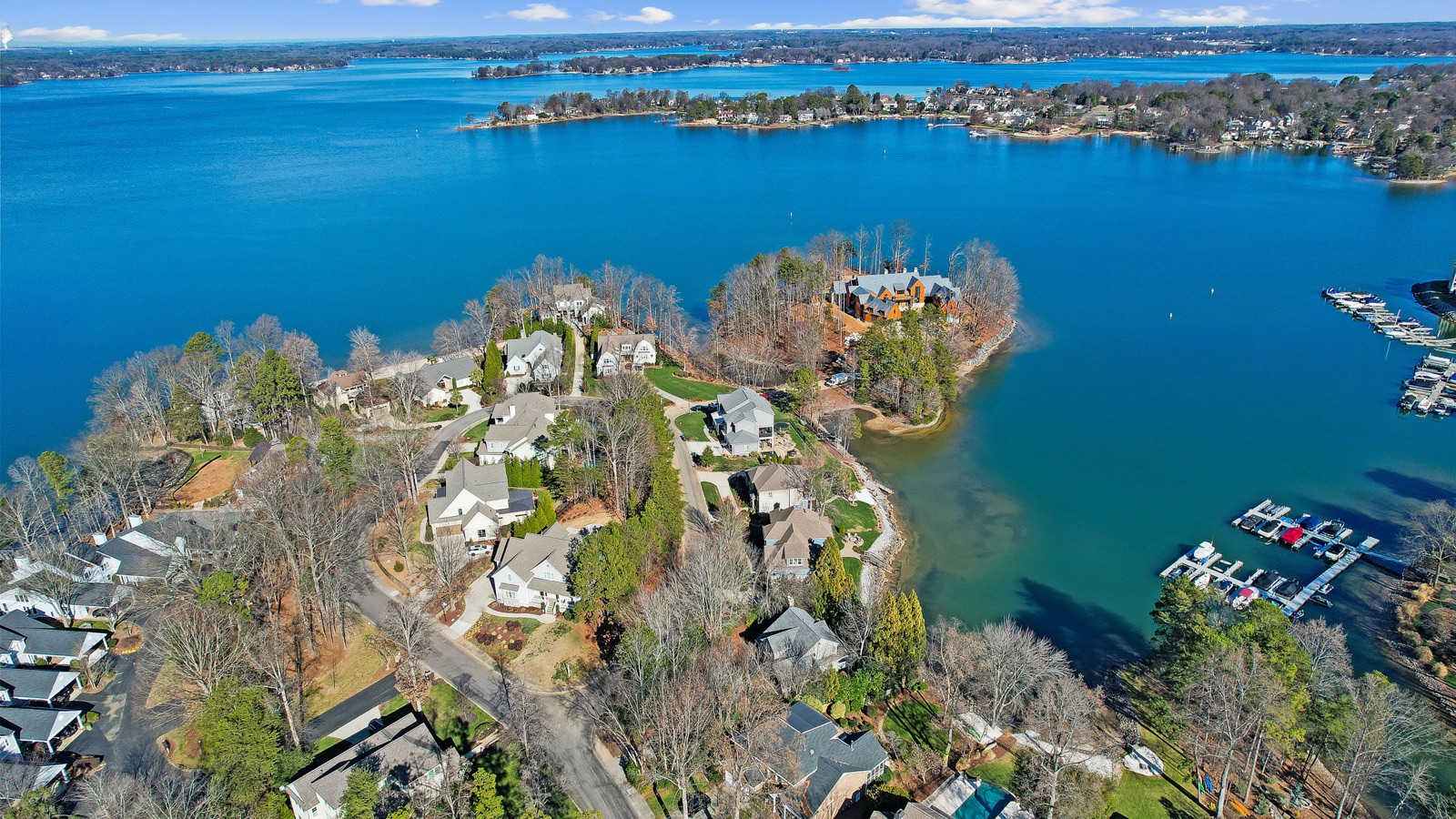
Sean works with our waterfront, luxury and relocating buyers; Wendy has represented buyers from The Point in Mooresville to Island Point Road in Sherrills Ford. Whether you already own on the lake or plan to move to Lake Norman from out of state, the questions below are the ones that decide a waterfront purchase, in the order we work through them.
What does waterfront cost in each part of the lake?
Across Lake Norman, the typical waterfront home closed at $989,000 over the twelve months ending October 31, 2026, at $358 per square foot. That is a 73% premium per square foot over homes off the water. The price moves most with the town, the county and what kind of water rights come with the home.
Published Lake Norman waterfront figures often disagree because they count different things. We publish two sets, each defined and dated. The twelve-month set is the broad count from our monthly market update. The May set is 22 closings we verified one by one as direct frontage, with water-view and access-only homes taken out, so it runs higher and is a one-month snapshot.
| Lake Norman waterfront | Twelve months ending Oct 31, 2026 | Verified direct frontage, May 2026 |
|---|---|---|
| Closings | 826 | 22, across the lake's four counties |
| Median sale price | $989,000 | $1,653,982 |
| Median price per square foot | $358 | $606 |
| Time or terms | Median 30 days to contract (33 for homes off the water) | Sellers received 96.6% of asking on average |
| Range | — | Mid-$400,000s to $12.5 million; 45% closed under $1.5 million |
| For sale | 362 waterfront homes on November 2, 2026, about 5.3 months of supply | — |
Waterfront prices by county and town
Lake Norman touches four counties, and each part of the lake has its own price range for waterfront homes. What our data shows, town by town:
| Part of the lake | Towns | What the waterfront data shows |
|---|---|---|
| Iredell County | Mooresville, Troutman | Mooresville has the most waterfront sales on the lake: 341 in the twelve months ending October 31, 2026, at a median of $1,085,000. It also carried half of the verified May closings (11 of 22, median $1.465 million). Realistic direct-frontage entry around Troutman ran roughly $950,000 to $990,000 in May 2026. |
| Mecklenburg County | Cornelius, Davidson, Huntersville | Cornelius carries the highest waterfront price per square foot on the lake, $420 over the twelve months ending October 31, 2026. Its two verified May closings averaged $3.56 million. The lake's biggest 2026 sale through our August report was $12.5 million on Island Drive in Huntersville. |
| Lincoln County | Denver | Four verified waterfront closings in May 2026 at a median of $1.86 million, and waterfront townhomes starting around $560,000. |
| Catawba County | Sherrills Ford, Terrell | Realistic direct-frontage entry around Sherrills Ford ran roughly $950,000 to $990,000 in May 2026, and Catawba County's property tax rate is roughly half of Mecklenburg's (see the tax question below). |
Frontage, a deeded slip or a view: what each adds to the price
"Waterfront" on Lake Norman can mean at least five different things, and a home's description often uses one word for all of them: a private dock on your own shoreline, a deeded slip in a community dock that travels with the deed, an offsite slip that may or may not transfer, community access through an association, or a water view with no water rights at all. The deed, the plat, the association documents and the dock permit say which one you are buying.
The price follows the rights. Our pricing model holds the rest of the house constant and reads what each feature adds. Across the Lake Norman towns, a waterfront lot with its own dock closes for 48% more in Cornelius, 62% more in Huntersville, about 90% more in Mooresville and Denver, and over 100% more around Troutman, Sherrills Ford and Terrell than the same house off the water. A deeded boat slip adds 25% to 62%, community water access 11% to 14%, and a water view without frontage 12% to 32% (Winston Dane market model, October 2026 update). Paying a dock price for a view is an expensive mistake, and an easy one to avoid.
Want the whole market behind these numbers? Our Lake Norman market report carries the verified waterfront closings, the luxury tier and the town-by-town figures.
Main channel or cove: what's the difference?
The main channel is Lake Norman's big open water, with long views and more wind and wake. A cove is protected water off the channel, often no-wake, for swimming and paddleboards. Neither is better. They are different water, and the price per foot of shoreline follows the difference.
- Wind and wake. Main-channel docks take more wind and wake; a protected cove takes less. Look at the dock on a busy summer weekend and on a windy day if you can.
- Depth. Depth varies cove by cove, and a shallow cove looks its worst when the lake is down. That is the depth question below.
- The route to open water. A boat with a tower, a sailboat mast or a tall cruiser may not clear every bridge on the lake. If a bridge sits between the dock and the main channel, measure your boat against it before you write an offer.
- What the dock can become. Duke Energy limits a private dock to one-third of the distance to the opposite shoreline or 120 feet lakeward of full pond, whichever is shorter. In a narrow cove, the dock you see may already be the largest the cove allows.
Two homes we have represented buyers on show the range: a Cornelius home in Sterling Pointe with about 172 feet of shoreline and main-channel views from almost every room, and a Sherrills Ford home on Island Point Road with deep water year-round in a no-wake area. Same lake, a different daily life on the water.
How deep is the water at the dock, and what happens in a drawdown?
Ask for the depth at the end of the dock with the date it was measured and Duke Energy's lake-level reading that day. A depth without a date tells you very little, because Lake Norman is a managed reservoir and its level moves: it is drawn down in winter, and it drops further in a dry year. A boat that floats at the dock in June can sit in mud in February.
Lake Norman's full pond is 760.0 feet above sea level, and Duke reports the level on a scale where full pond reads 100. 2026 has been a low-water year. The Catawba-Wateree basin entered Stage 2 of Duke's Low Inflow Protocol on May 1, 2026; on May 18, WBTV reported Lake Norman at 94 on Duke's scale against a May five-year average of about 98, with four ramps closed at Blythe Landing; and the City of Hickory's drought page still showed Stage 2 when it was updated on October 16, 2026.
- Check the level the day you tour. Duke's lake-level line is 800-829-5253, and the free Lake View app shows the same reading.
- Read the photos for the season. Full green trees and water up to the shoreline is summer. Bare trees, an exposed bank or a dock over mud is the drawdown. Never treat full-pond photos as today's water.
- A winter tour is useful. If you see a waterfront home in the drawdown, you are close to seeing the worst of it, and that is worth knowing before you buy.
- Ask where the boat sat in a dry year. The seller's answer, and any dated photos, tell you more than a summer showing.
Does the dock permit come with the house?
Not automatically. Piers, docks, boat lifts and shoreline work on Lake Norman are permitted by Duke Energy Lake Services. When you buy a waterfront home, you apply to transfer the permit into your name through Duke's online Lake Access Permit System (LAPS), and Lake Services inspects the dock for anything changed without approval. Duke's guidance says the applicant or the current owner will likely be responsible for correcting it.
Duke releases a property's permitting history only to the current owner, and only once the permit is in that owner's name. Not to agents and not to buyers. So the paperwork has to come from the seller. The full due diligence list, from the 760 line to flood insurance and septic, is in our guide to what to check before you buy a waterfront home on Lake Norman. Before or during due diligence, we ask for:
- The pier permit and its application, in the seller's name, and a photo of the permit tag on the pier.
- The seller's permitting history from Duke Lake Services (800-443-5193).
- A plain account of anything added since the permit was issued: a lift, a roof, a slip extension, a second deck.
- Permits for any riprap, seawall or other shoreline stabilization.
The transfer fee. Duke's Lake Services fee schedule effective January 15, 2025 lists "Transfer of Existing Facility" at $500. The schedule can change without notice, so confirm the current figure with Duke.
If you want a bigger or different dock. Duke answers actual applications, not hypotheticals. Its information sheet says a purchaser who needs a change should require the seller to get Duke's approval before closing; those approvals are good for one year and transfer to the new owner.
| Duke rule (private dock) | What it means when you buy |
|---|---|
| Up to 1,000 square feet and two slips or lifts | An older dock larger than today's limit can stay, but it may not take additions, including a roof over an existing part. |
| A lot with less than 100 feet of shoreline cannot get a new pier unless it was subdivided and recorded before September 1, 2006 | Ask for the shoreline footage and the plat's recording date, especially on a lot with no dock yet. |
| One dock per lot, with exceptions for docks permitted before June 1, 1996 | A second structure on the lot needs its own answer from Duke. |
| Since July 1, 2026, no review of private dock applications where no home has been built on the lot | On a vacant waterfront lot, a dock can come only after the house. |
The 760 line and the buffer. The 760 line is the lake's full-pond level, and it is not the lot line; only a survey shows where the lot stops. North Carolina's Catawba River buffer rule (15A NCAC 02B .0614) sets a 50-foot buffer landward from full pond: the first 30 feet left undisturbed except for allowed uses, the next 20 feet managed vegetation. If you are counting on a pool, a lawn or a cleared view on the lake side, check the buffer on the survey first. Our Lake Norman waterfront seller guide has the full Duke and buffer walkthrough, with every source and date.
Why is the tax bill different across the lake?
Because Lake Norman sits in four counties, and each sets its own property tax rate. The same water can carry a very different bill: Catawba County's rate ($0.3985 per $100 of value, as published in our August 2026 market report) is roughly half of Mecklenburg County's. On a median waterfront home, that difference is on the order of $55,000 over ten years.
- Mecklenburg County: Cornelius, Davidson and Huntersville. The county revalues effective January 1, 2027; its September 2, 2026 update reported a median increase of about 15% for residential parcels in its initial review.
- Iredell County: Mooresville, Troutman and Statesville. The NC Department of Revenue lists the next scheduled reappraisal as 2027; the last took effect January 1, 2023.
- Lincoln County: Denver. Next reappraisal effective January 1, 2027.
- Catawba County: Sherrills Ford and Terrell. Revalues every four years; the last took effect January 1, 2023.
We have not printed Iredell's or Lincoln's rate on this page. For any home you are serious about, the number to use is that parcel's most recent tax bill, read against the 2027 revaluation in its county. Rates can change each year: confirm with the county tax office, and ask a CPA how the bill fits your own situation. Nothing here is tax advice.
What should I check before I make an offer?
On the water, the questions that decide the deal are rarely about the kitchen. Before an offer on a Lake Norman waterfront home, confirm what kind of water rights convey, that the dock matches its permit, the depth at a stated lake level, and what the survey, the flood map and the tax bill say. When you buy with us, these water items sit inside the inspection period.
- The rights: private dock, deeded slip, offsite slip, community access or view only, in the deed, the plat and the association documents. A deeded slip conveys with the house; a leased slip may carry a waitlist and an annual fee; an "assigned" community slip is neither.
- The permit: in the seller's name, with the application, the tag number and a list of anything added since (see the permit question above).
- The depth: at the end of the dock, with the date and Duke's lake-level reading.
- The route: cove or main channel, and any bridge between the dock and open water.
- The survey: the shoreline, the 760 line, the 50-foot buffer, the shoreline footage and the plat's recording date.
- The shoreline: riprap, seawall or natural bank, photographed on the first visit and looked at by someone qualified. It is a five-figure item nobody inspects like the roof.
- The dock itself: who wired the dock electrical and when; the boat lift's make, capacity, age and service records.
- The lot: the watershed limit on how much of the lot can be covered by house, driveway and pool, whether or not it touches the water.
- Costs and coverage: flood zone status from the FEMA map, an elevation certificate if there is one, and a homeowners (and flood) insurance quote.
- The rules: HOA documents, covenants, slip and dock rules, and any minimum rental term, read before you write the offer, not after. Some lake homes come with a short-term rental history; some communities limit it.
- Septic and well records, if the home is on either.
- The disclosure statement: North Carolina sellers give buyers the Residential Property and Owners' Association Disclosure Statement (N.C.G.S. Chapter 47E), with flood questions added effective July 1, 2024. It does not ask about Duke permits by name, so ask separately.
North Carolina closings run through an attorney; for anything legal about the deed, the slip or the permit, ask yours. Looking at a specific Lake Norman home right now? Run it through the Waterfront Truth Check: nine questions about that one home, free, with the result on the page.
Ready to see what is on the water today? Search Lake Norman waterfront homes for sale, with new listings as they come on, or search Lake Norman homes for sale at $1M+. Then call or text 704-912-0999 and tell us the water you want and the price band.